Business process improvement (BPI) is a systematic approach to help an organization optimize its underlying processes to achieve more efficient results. The methodology was first documented in H. James Harrington’s 1991 book Business Process Improvement.

⚖️ From SEO to AEO: Why Law Firms Must Rethink Digital Visibility in the Age of AI

For years, law firms have invested heavily in SEO (Search Engine Optimisation) — building keyword-rich websites, publishing blogs, and chasing Google rankings.

But the landscape is changing. Fast.

With the rise of AI-powered “answer engines” like ChatGPT, Perplexity, and even Google’s Search Generative Experience, people are no longer just searching for links. They are asking questions — and expecting direct, authoritative answers.

This is where AEO (Ask Engine Optimisation) comes in.


1. What is AEO?

Ask Engine Optimisation is the process of making sure your firm’s expertise shows up when clients ask AI tools (not just search engines) for legal answers.

Instead of optimising for keywords like “best family lawyer in Manchester”, AEO focuses on structured, credible, machine-readable knowledge that AI systems can pull from when generating answers.

In short:

  • SEO = ranking in Google
  • AEO = being the answer in AI-driven platforms

2. Why SEO is Dying (for Law Firms)

SEO isn’t going to vanish overnight — but it’s no longer enough on its own.

Why?

  • AI answer engines bypass links. They summarise, they don’t send traffic.
  • Voice and chat are rising. Clients are asking Alexa, Siri, or ChatGPT legal questions directly.
  • Trust matters more. AI models weigh authority, citations, and structured data, not just backlinks and keywords.

If your firm relies only on SEO, you risk becoming invisible in the spaces where clients increasingly look for answers.


3. How Law Firms Can Practically Apply AEO

Here’s what forward-thinking firms should start doing today:

🔹 Structured Data & Schema Markup Make your content machine-readable so AI engines can easily verify and pull from it.

🔹 Authoritative Content, Not Clickbait AI tools look for substance: detailed legal guides, FAQs, case studies, jurisdiction-specific explanations.

🔹 Q&A Format Think like your clients: “How do I file for divorce in England?” / “What are the steps for I-130 in Kansas?” Format content around real questions clients ask.

🔹 Consistency Across Platforms Ensure your lawyers’ bios, case focus, and jurisdictional expertise are consistent across directories, LinkedIn, and your firm’s site.

🔹 Reputation & Citations AI tools increasingly weigh external credibility. Publish in legal journals, contribute to bar associations, and get cited online.


4. The Competitive Advantage for Early Movers

Most firms are still chasing traditional SEO. But the ones who pivot now to AEO will: ✅ Appear in AI-generated answers before competitors ✅ Build stronger digital authority ✅ Future-proof their marketing spend


⚖️ Final Thought

For law firms, the shift from SEO to AEO is not optional. It’s the difference between being a link on page three and being the answer a potential client actually sees.

Lawyers don’t just need visibility. They need trust, clarity, and authority in the places clients are now asking questions.

The future isn’t search-first. It’s ask-first.

#AEO #LegalMarketing #LegalTech #FutureOfLaw #LawFirmGrowth #AIinLaw

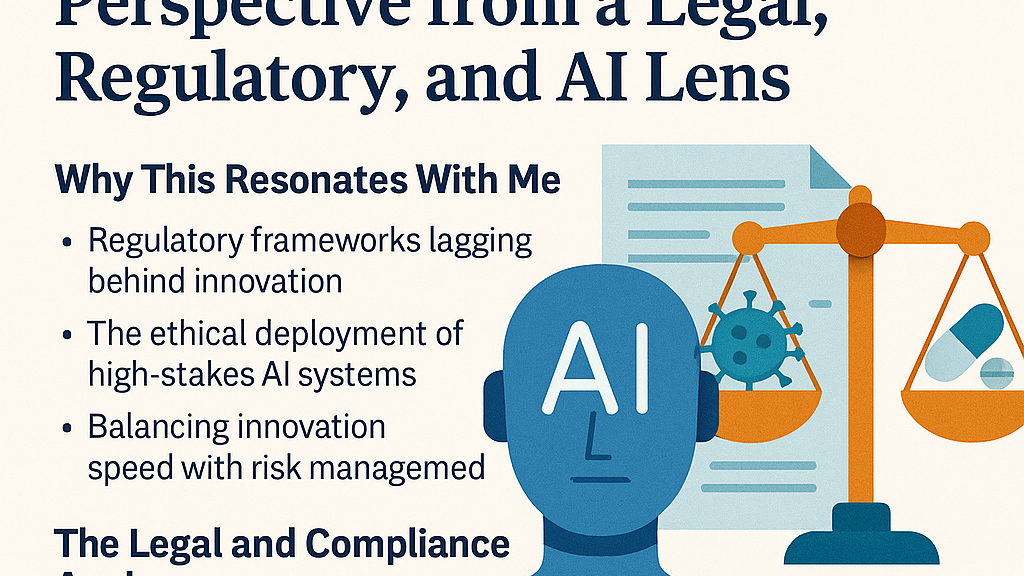
Could AI Save Us from the Antibiotic Apocalypse? My Perspective from a Legal, Regulatory, and AI Lens

The Sky News report by Thomas Moore highlights groundbreaking research from MIT, where generative AI is being used to design entirely new antibiotics against deadly superbugs like MRSA and drug-resistant gonorrhoea.

This isn’t just a medical milestone—it’s an AI milestone with far-reaching implications across law, regulation, and public health policy.

Why This Resonates With Me

My work sits at the intersection of AI, law, and access to justice—and while my focus is often on legaltech, the principles and challenges in medtech AI mirror those in my sector:

  • Regulatory frameworks lagging behind innovation
  • The ethical deployment of high-stakes AI systems
  • Balancing innovation speed with risk management

Antibiotic resistance is a global crisis, killing around five million people a year. The fact that the last major class of antibiotics was discovered in the 1980s underscores the urgency. AI’s ability to design molecules atom-by-atom and model their toxicity before they’re ever synthesised could dramatically accelerate the drug discovery pipeline—something traditional R&D has struggled to do efficiently.

The Legal and Compliance Angle

The AI-driven drug discovery process raises important legal considerations:

  • Data governance: What patient datasets (if any) are used in training models, and how is consent handled?
  • Regulatory approval: How will agencies like the FDA, EMA, or MHRA adapt review processes for drugs discovered by algorithms?
  • Liability: If an AI-designed antibiotic later has unforeseen side effects, where does legal responsibility fall—developer, manufacturer, or AI system owner?

Lessons for Legaltech

The parallel is striking: in both drug discovery and legal services, AI’s value lies in its ability to generate, filter, and optimise possibilities far beyond human capacity—whether that’s millions of molecules or millions of legal scenarios. The challenge in both is trust:

  • Trust in the AI’s process
  • Trust in the verification methods
  • Trust in the governance that oversees deployment

Why It Matters Now

Many pharmaceutical companies abandoned antibiotic R&D due to cost and high failure rates. If AI can reduce that risk, it may revive an industry segment vital to human survival. Similarly, in law, AI may revive and expand access to legal support where human resource shortages and cost barriers have historically restricted it.

Both fields stand to benefit from reduced development cycles, lower costs, and more personalised, effective solutions—but both will fail without robust ethical, regulatory, and societal safeguards.


Closing Thought: If AI can help us avert an antibiotic apocalypse, it will be because humans built the right frameworks around it—legal, ethical, and operational. That’s as true for healthcare as it is for the justice system.

🚀 This Week in ChatGPT & GPT-5: What Legal Professionals Need to Know

Quick Takeaways

  • GPT-5 just got smarter – major advances in agentic workflows, coding ability, and long-context reasoning.
  • New Responses API lets the model “remember” its own reasoning between steps, cutting costs and latency.
  • Legal relevance: faster case prep, better doc review, and improved AI-driven legal research.
  • Prompting Guide release shows how to control GPT-5’s autonomy — key for compliance-sensitive work like law.
  • Action now: experiment with reasoning effort settings, set clear AI “guardrails,” and integrate AI into legal workflows before competitors do.

1. What Happened in the GPT-5 World This Week

OpenAI has just made one of the most significant leaps forward in AI usability since the launch of GPT-4.1 — and this week’s announcements, product updates, and community experiments give us a clear picture of where this is going.

The highlights:

  • Launch of the GPT-5 Prompting Guide — a deep technical document from OpenAI’s own team, showing how to get maximum performance from the new model.
  • Expanded agentic capabilities — GPT-5 can now operate more autonomously, managing multi-step workflows with less human intervention while giving progress updates.
  • The Responses API — a major infrastructure upgrade allowing GPT-5 to carry forward its own reasoning between tool calls. In plain English: the AI now remembers why it made a decision, so it doesn’t have to re-explain or re-calculate every time.
  • Granular control over “reasoning effort” and “verbosity” — two parameters that let you dial up deep thinking or force concise answers depending on the task.
  • Code and workflow performance gains — originally aimed at developers, but equally important for law: the model can now handle large, interconnected information sets with fewer errors and faster turnaround.

While the public headlines focus on AI coding and software engineering, there’s an enormous legal angle here. Because if GPT-5 can handle multi-file refactoring in codebases, it can handle multi-document refactoring in legal matters — from contract portfolios to evidence bundles.


2. Why This Matters for the Legal Sector

2.1 AI That “Remembers” Between Steps

In legal work, most tasks are not single-shot queries — they’re multi-stage processes:

  1. Gather facts.
  2. Check relevant law.
  3. Apply to the facts.
  4. Draft advice or pleadings.

Previously, ChatGPT would “forget” its own internal reasoning between API calls or tool interactions. That meant it had to re-process context at every step, increasing both time and cost.

The Responses API changes that: it carries forward reasoning traces, so the AI remembers the logical path it took in earlier steps. In a legal research setting, this means:

  • More consistent analysis across large bundles of documents.
  • Less risk of contradictory conclusions between drafts.
  • Lower latency when generating multiple related outputs (e.g., an advice note, skeleton argument, and witness statement that all draw from the same core reasoning).

2.2 Controlling AI Autonomy in a Compliance-Heavy Field

The Prompting Guide introduces a way to tune “agentic eagerness” — in other words, how proactive the AI should be in making decisions without asking you first.

In legal practice, this is gold. Why? Because in regulated industries, you need to set clear guardrails:

  • High autonomy for safe, repetitive tasks (e.g., pulling all case citations from a set of judgments).
  • Low autonomy for high-risk actions (e.g., advising on settlement figures or filing documents with a court).

The guide even gives XML-style prompt structures that explicitly define when an AI can and cannot proceed without human input — something compliance teams will appreciate.

2.3 Long-Context Mastery

GPT-5’s long-context capabilities mean you can load hundreds of pages of case law, contracts, or evidence, and it can:

  • Retain the logical structure of the entire dataset.
  • Make cross-references between far-apart documents.
  • Avoid losing track of earlier facts when producing late-stage outputs.

This is the dream for litigation teams drowning in disclosure.


3. Inside the GPT-5 Prompting Guide — Legal Applications

The guide is written for developers, but its lessons map directly to legal use cases. Let’s break down the most relevant parts.

3.1 Reasoning Effort

  • Low reasoning effort = faster answers, good for routine lookups or confirming known facts.
  • High reasoning effort = deeper exploration, better for novel, complex legal questions.

Example:

  • Low effort: “List all limitation periods in UK tort law.”
  • High effort: “Analyse the interaction between limitation periods and latent damage in UK tort law, with references to relevant case law and statutes.”

3.2 Tool Preambles

In law, transparency is everything. GPT-5 can now provide structured preambles:

  • Restating the client’s question.
  • Outlining its plan for answering it.
  • Updating you on progress at each stage.

Imagine an AI legal assistant that starts by saying:

“You’ve asked for an analysis of GDPR compliance in a proposed client onboarding process. I will: (1) summarise the process, (2) identify GDPR triggers, (3) cross-check against Articles 6, 9, and 32, (4) flag any potential risks.”

That’s audit-ready work.

3.3 Matching Style & Standards

The guide covers codebase consistency — in legal terms, think “house style.” You can now prompt GPT-5 to:

  • Use your firm’s preferred drafting style.
  • Follow specific citation formats.
  • Maintain consistent clause numbering and terminology.

This is essential for firms wanting to use AI without having every document feel like it was written by a different junior.

3.4 Avoiding Contradictions

One of the guide’s key warnings: GPT-5 will take contradictory instructions very literally and waste reasoning cycles trying to reconcile them. For law firms, that means:

  • Prompts must be clear and free from internal conflicts.
  • Internal AI style guides should be reviewed like precedent banks — for logical consistency.

4. Strategic Implications for Legal Practice

4.1 Litigation Support

  • Document review: faster triage of disclosure, with AI flagging relevance and privilege.
  • Chronology building: AI can maintain a consistent case timeline across hundreds of exhibits.
  • Skeleton arguments: pre-structured drafting that draws from the same reasoning pool as earlier case analysis.

4.2 Transactional Law

  • Contract drafting: merge standard clauses with bespoke amendments while keeping a coherent style.
  • Due diligence: AI can now process entire data rooms in fewer passes, remembering key findings between steps.
  • Regulatory compliance: configure “low autonomy” modes for filings to avoid unauthorised submissions.

4.3 Access to Justice

  • Self-service legal tools: community legal centres could deploy GPT-5-powered chatbots with controlled reasoning levels, helping the public understand rights without giving unverified advice.
  • Language accessibility: verbosity controls allow plain-English summaries for non-lawyers, while maintaining detailed legal notes for practitioners.

5. How to Act on This — Now

Here’s a 5-step adoption roadmap based on the week’s developments:

  1. Identify candidate workflows — Pick 2–3 legal processes that are repetitive, text-heavy, and have low-to-moderate compliance risk.
  2. Experiment with reasoning effort — Try both low and high settings on the same task and measure accuracy, cost, and speed.
  3. Define autonomy guardrails — Use the prompting guide’s agentic eagerness controls to decide when AI can act without human sign-off.
  4. Integrate tool preambles — Insist on upfront plans and progress updates for auditability.
  5. Review and refine prompts — Test for contradictions and vague instructions that could derail reasoning.

6. Final Thoughts

This week marks a turning point: GPT-5 is no longer just a “better text generator” — it’s a controllable, auditable, reasoning-capable assistant that can slot directly into complex, compliance-sensitive industries like law.

The release of the GPT-5 Prompting Guide is a gift to the profession: it’s effectively a blueprint for how to talk to AI so it works the way you need it to. Combined with the Responses API and the new control levers for reasoning and verbosity, we now have the tools to make AI a trusted, documented part of the legal process — not a black-box experiment.

Lawyers who act early will be the ones setting the standards. Those who wait risk being handed a standard someone else has already written.


💬 Over to You: How do you see GPT-5 fitting into your legal workflow? Will you be experimenting with high-reasoning modes, or keeping the AI on a short leash?

#AI #LegalTech #GPT5 #LawPractice #ChatGPT #LegalInnovation #PromptEngineering #AccessToJustice #Litigation #ContractLaw

Apple’s Voice-First Overhaul: What It Means for Legal Tech (and Why Family Law Practitioners Should Care)

Apple is reportedly preparing a voice-first transformation of Siri—slated for spring 2026 with iOS 26.4—that could fundamentally change how we interact with devices and apps.

With an enhanced App Intents framework, users will be able to control apps entirely by voice, executing complex, multi-step tasks like:

  • Editing and sending legal documents or evidence images
  • Filing or updating court forms
  • Posting to client portals or social media
  • Making payments or managing banking transactions
  • Booking professional services or appointments
  • Accessing healthcare or support services

For legal technology—including tools used in international family law—this shift offers both groundbreaking opportunities and serious challenges in areas like compliance, accessibility, privacy, and liability.


Why Family Law Practitioners Should Pay Attention

While the headlines focus on convenience, the real impact will be in how voice-first systems can transform client communication, document handling, and evidence gathering.

Imagine:

  • A client in another jurisdiction securely dictating their witness statement straight into your case management system.
  • Voice-triggered retrieval of case law or court directions mid-meeting.
  • Instant transcription and filing of parenting schedules or financial disclosure updates.

These capabilities could be a lifeline for clients with disabilities, limited literacy, or high emotional stress—but only if implemented safely and inclusively.


Key Legal Tech Implications

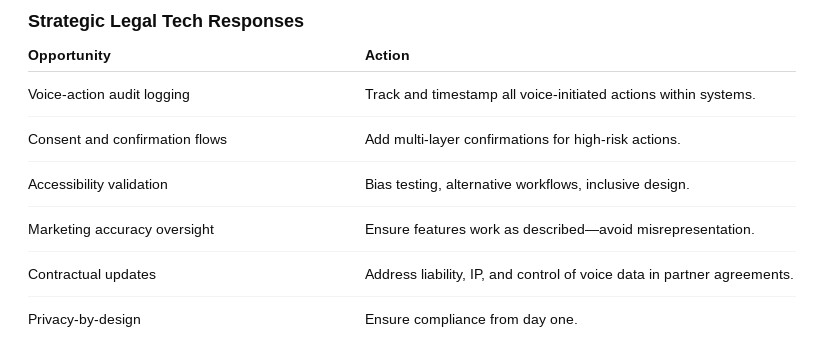
  1. Regulatory Risks Around Voice-Based Transactions Transferring funds or sharing sensitive data via voice will require robust authentication, explicit consent, and auditable logs—with compliance spanning GDPR, UK Data Protection Act, HIPAA, and jurisdiction-specific rules.
  2. Accessibility & Inclusion Voice interfaces can boost accessibility but risk exclusion if speech recognition struggles with accents, impairments, or noisy environments. Tools must meet obligations under the UK Equality Act and similar laws.
  3. Liability for Mis-Triggered Actions Misheard commands could cause financial loss or accidental disclosure. Clear confirmation steps and “undo” functions are essential.
  4. E-Discovery & Audit Readiness Verifiable, timestamped audit trails of voice actions will be vital in regulated environments—and invaluable if court proceedings require review.
  5. Updated Contracts & IP Integration with third-party apps will require revisiting agreements to clarify IP, data control, and liability in case of misuse.
  6. Privacy & Data Handling Voice brings unique privacy risks. Systems must adopt privacy-by-design to ensure lawful, transparent, and user-centric processing.

My Take

As someone interested in the intersection of international family law and legal tech, I see this as more than just a UI upgrade. It’s a paradigm shift that could:

  • Reduce barriers for vulnerable clients
  • Speed up case preparation across borders
  • Support truly inclusive digital justice …but it will also demand proactive governance to prevent abuse, discrimination, or compliance breaches.

Firms that start preparing now—by building audit trails, consent layers, and inclusive design principles—will not only protect themselves legally but also lead the way in client service innovation.


💬 What’s your view? Will voice-first tech be an accessibility breakthrough or a compliance minefield for family law? I’d love to hear how your team is preparing—and whether you think clients will trust voice for legal interactions.

#LegalTech #InternationalFamilyLaw #DigitalJustice #AccessToJustice #AI #PrivacyByDesign #Apple #VoiceFirst #LawTechInnovation

Apple’s Voice-First Overhaul: What It Means for Legal Tech

Apple is reportedly planning a voice-first transformation of Siri that could fundamentally change how users interact with devices and apps. Slated for release in spring 2026 with iOS 26.4, this overhaul will leverage an enhanced App Intents framework—allowing users to control apps entirely by voice, including executing complex, multi-step tasks like:

  • Editing and sending documents or images
  • Posting to social media
  • Making purchases or banking transactions
  • Booking appointments
  • Accessing healthcare services

The potential is huge—but so are the legal, compliance, and risk implications. For legal tech professionals, this development opens both opportunities and challenges in compliance, accessibility, privacy, and liability management.


Key Legal Tech Implications

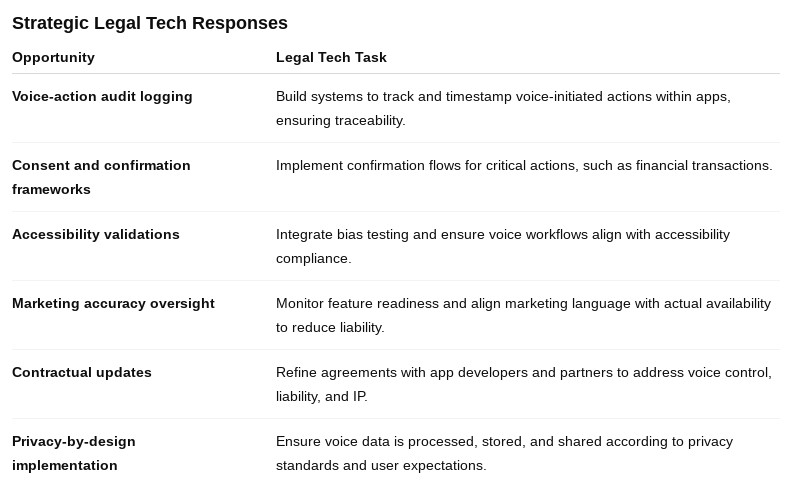
1. New Regulatory Risks Around Voice-Based Transactions Voice commands enabling sensitive actions—such as transferring funds or accessing personal health data—will demand robust authentication, explicit consent, and auditable logs. Compliance with GDPR, UK Data Protection Act, HIPAA (US), and other jurisdiction-specific rules will be critical.

2. Accessibility & Inclusion Requirements Voice interfaces can be a game-changer for accessibility—but also risk exclusion if speech recognition fails for diverse accents, speech impairments, or noisy settings. Legal tech must ensure accessibility testing, bias detection, and alternative controls to meet obligations under laws like the UK Equality Act.

3. Liability for Mis-Triggered Actions A misunderstood voice command could trigger an unintended purchase, post, or data disclosure. Clear “confirmation” layers and undo functions will be vital to mitigate legal disputes.

4. Compliance, E-Discovery & Audit Readiness Voice actions will need verifiable audit trails—including timestamps, user identity confirmation, and accurate transcripts. This is especially relevant for regulated industries where voice-initiated activity could be subject to investigation or litigation.

5. Intellectual Property & Third-Party Contracts Apple’s integration with third-party developers will require updated agreements covering IP ownership of voice-triggered processes, data control, and liability in case of errors or misuse.

6. Consumer Protection & Marketing Claims Past lawsuits have shown the risks of marketing features that aren’t ready or don’t work as advertised. Voice-first capabilities must be staged, tested, and truthfully represented to avoid false advertising claims.

7. Privacy & Data Handling Challenges Voice interactions bring unique privacy risks, such as unintended recording of sensitive information. Legal tech will need to build privacy-by-design frameworks to ensure lawful, transparent, and user-centric voice data handling.

The Bottom Line for Legal Tech Leaders

Apple’s voice-first evolution represents a paradigm shift in digital interaction—one that legal tech can’t afford to ignore. From risk mitigation to compliance innovation, there’s an urgent need for legal technology providers, in-house teams, and law firms to start preparing now for voice-driven workflows.

Firms that adapt early—by implementing audit trails, robust consent flows, inclusive design, and updated contractual frameworks—will not only stay compliant but also position themselves at the forefront of the next wave of user-interface transformation.


💬 What’s your view? Will voice-first legal tech be an accessibility breakthrough, or a compliance minefield? I’d love to hear how your firm or team is preparing.

AI Across Borders: My Reflections on the UK’s Path in a Rapidly Changing Legal Landscape

When I sat down to read Law Over Borders: Artificial Intelligence, I wasn’t expecting it to feel quite so personal. Yes, it’s a global legal guide — packed with the usual comparative charts, statutory references, and jurisdictional summaries. But as I read through the chapters on how different countries are approaching AI regulation, I couldn’t help but see my own professional journey reflected in its pages.

I’m a barrister-in-training with a deep interest in legaltech and business strategy. I split my professional life between the UK and the US — two very different legal ecosystems that are both grappling with the same question: How do we regulate artificial intelligence without suffocating innovation?

The guide’s UK chapter hit home for me. It reminded me just how unique our approach is — cautious in tone, pro-innovation in intention, and pragmatic in execution. We haven’t gone down the EU AI Act route of sweeping, horizontal legislation. Instead, the UK government has placed its bets on a sector-by-sector regulatory model, underpinned by a set of five cross-cutting principles:

  1. Safety, security and robustness
  2. Appropriate transparency and explainability
  3. Fairness
  4. Accountability and governance
  5. Contestability and redress

These principles aren’t just abstract. If you’re a UK lawyer, they’re already seeping into our work — influencing contract drafting, due diligence, risk assessments, and even how we think about professional negligence in an AI-assisted age.


A UK Lens on a Global Conversation

Reading the global comparisons in Law Over Borders, I felt an odd mix of reassurance and unease. Reassurance, because the UK’s light-touch, regulator-led approach means we can move faster than jurisdictions locked into legislative overhauls. Unease, because this flexibility comes with a cost — we risk being too reactive, too fragmented, and ultimately outpaced by those who set firmer guardrails early.

Take the EU AI Act. Its risk-based framework — with clear definitions of prohibited, high-risk, and low-risk systems — offers a kind of legal certainty that many businesses crave. But it’s also bureaucratically heavy. For a start-up or SME working with AI, the compliance burden could be daunting.

In contrast, the UK’s “wait and see” stance feels business-friendly. We’re inviting innovation, experimenting with regulatory sandboxes, and asking each sector’s existing regulators to interpret AI risks within their own domain. That’s agile governance in theory — but in practice, it demands a lot from regulators who may not have deep AI expertise yet.


Why This Matters to My Work

For me, this isn’t an abstract policy debate. As someone preparing to practise in litigation and dispute resolution — and advising on legal technology — I can already see how AI regulation will shape the disputes of tomorrow.

  • Contractual disputes over AI system performance are inevitable. Without statutory definitions, parties will fight over what counts as “fair” or “explainable.”
  • Negligence claims may arise when professionals rely on AI outputs without sufficient human oversight.
  • Cross-border enforcement will be messy — particularly where AI systems developed in one jurisdiction cause harm in another.

The UK’s approach puts a premium on professional judgment. That excites me as a lawyer — it keeps the role of human legal reasoning front and centre — but it also increases the burden on us to stay informed, anticipate risk, and advise clients in an evolving landscape.


The Human Rights Thread

One of the most striking themes in Law Over Borders was the interplay between AI regulation and human rights law. The UK has retained the Human Rights Act, which means Article 8 ECHR (right to privacy) and Article 14 (non-discrimination) remain core legal touchpoints for AI oversight.

But unlike the EU, we haven’t enshrined AI-specific human rights protections into statute. That puts the onus on courts and regulators to interpret existing rights in light of new technologies.

From my perspective, this flexibility is a double-edged sword. It allows our legal system to adapt case-by-case, but it also risks inconsistent protection — and for individuals harmed by AI-driven decisions, that can mean justice delayed or denied.


Bias and Accountability: The Hidden Challenge

The guide’s discussion of bias and discrimination resonated deeply. Whether it’s recruitment algorithms, predictive policing tools, or credit scoring systems, AI can encode and amplify existing inequalities.

The UK’s Equality Act 2010 already provides a legal framework for tackling discrimination — but AI challenges our enforcement toolkit. Bias in AI is often statistical, buried in datasets or model architecture, making it harder to prove causation in court.

In my legaltech work, I’ve seen a growing interest in algorithmic auditing and bias testing. I believe that within the next five years, UK lawyers will need to be conversant in at least the basics of model validation and data ethics. These won’t just be “tech team” issues — they’ll be matters of legal compliance, risk management, and reputation.


Learning from Abroad — Without Copying Blindly

The beauty of a comparative guide like Law Over Borders is that it reminds you: there’s no one-size-fits-all model for AI regulation.

  • The US leans heavily on sector-specific rules and private litigation to shape AI accountability.
  • The EU prefers codified obligations, backed by regulatory enforcement.
  • Australia has adopted a more principles-based, risk-oriented stance similar to ours, but with a sharper focus on consumer law.
  • Switzerland places strong emphasis on human oversight and transparency.

The UK’s challenge — and opportunity — is to synthesise the best elements of each without undermining our own regulatory DNA.


Practical Implications for UK Lawyers

From my reading, there are five things every UK legal professional should be doing right now:

  1. Track sectoral regulator guidance — from the FCA to the ICO, their interpretations of the five AI principles will shape the risk landscape.
  2. Understand AI supply chains — clients will increasingly need advice on contractual terms governing data use, model updates, and liability allocation.
  3. Build tech literacy — you don’t need to code, but you do need to understand how AI works, where it fails, and what “explainability” means in practice.
  4. Plan for disputes — think about evidential issues in proving or challenging AI-driven decisions.
  5. Engage in policy dialogue — lawyers have a voice in shaping proportionate, future-proof AI regulation. Use it.

Why I’m Optimistic — Cautiously

Despite my concerns about fragmentation and regulatory capacity, I’m optimistic about the UK’s trajectory. We have a strong legal tradition, adaptable common law principles, and a government that recognises the economic potential of AI.

But optimism must be paired with vigilance. Without consistent enforcement and a shared understanding of what our AI principles really mean in practice, we risk creating a regulatory patchwork that benefits the most sophisticated players while leaving individuals and SMEs exposed.


A Call to My Network

As lawyers or soon to be lawyers, we’re more than interpreters of the law — we’re shapers of it. If we approach AI with curiosity, rigour, and a willingness to collaborate across disciplines, the UK can be a leader in responsible innovation.

That means:

  • Joining cross-sector conversations
  • Contributing to consultations
  • Supporting ethical AI start-ups
  • Educating clients on both the risks and the opportunities

I’d love to hear from others working at the intersection of law and AI — whether you’re in private practice, in-house, academia, or policy. How do you see the UK’s approach evolving? And what should we be doing now to make sure it serves both innovation and justice?


This reflection was inspired by the excellent comparative insights in Law Over Borders: Artificial Intelligence. It’s a must-read for anyone navigating AI’s complex, cross-border legal landscape.


From Courtroom to Code: Why Every Future Barrister Must Speak Legaltech

In a world where your next opponent might be an algorithm, legaltech fluency isn’t optional — it’s essential.

When I began my PGDL and SQE journey, I imagined my barrister’s future as a careful balance of law, logic, and language. I pictured cross-examining witnesses, dissecting contracts, and delivering the kind of closing argument that silences a room.

What I didn’t picture was running cross-jurisdictional legal research through an AI model at 7am, or collaborating with solicitors via digital litigation platforms that render old-school filing cabinets obsolete.

But that’s the reality — and opportunity — for the modern advocate.


The Evolution of Advocacy

Advocacy has always been about persuasion, precision, and preparation. Those haven’t changed. What has changed is how we prepare:

  • From paper bundles to e-bundles
  • From library shelves to AI-powered research tools
  • From clerks’ diaries to automated case management systems

The barrister who can code-switch — moving seamlessly from courtroom rhetoric to digital efficiency — will be the one clients remember, and chambers rely on.


Why Legaltech Skills Matter More Than Ever

  1. Clients Expect It – Businesses live in a data-driven world. They assume their legal teams do too.
  2. Efficiency Wins Cases – Speed matters in litigation, especially in urgent applications or international disputes.
  3. Evidence Is Changing – Digital forensics, deepfake verification, and metadata analysis are no longer niche.

The Ethical Balancing Act

The challenge isn’t just adopting new tools — it’s adopting them responsibly. AI is only as good as the lawyer who verifies its output. That means:

  • Double-checking all AI-assisted research against primary sources.
  • Understanding confidentiality risks when using third-party tools.
  • Staying aware of evolving Bar Standards Board guidance on tech use.

Three Ways to Start Speaking Legaltech Today

  1. Shadow a Tech-Forward Law Firm – Spend a day observing their litigation support workflow.
  2. Master One Tool at a Time – Whether it’s e-disclosure software or AI research assistants, depth beats dabbling.
  3. Join the Conversation – Engage in legaltech forums, LinkedIn groups, or attend industry webinars.

From My Journey

Splitting my time between the UK and Kansas has given me a unique vantage point on how different legal markets embrace technology. The US tends to move faster in adoption; the UK tends to move deeper in refinement. The advocate who can learn from both worlds will thrive anywhere.


Final Thought: The courtroom will always need advocates. But the best advocates will also be fluent in the languages of data, automation, and innovation. Those who ignore this shift risk becoming fluent in a language no longer spoken.


Question for You: How ready is your legal practice for the tech-driven litigation of the next decade?

#LegalTech #FutureOfLaw #BarristerLife #LitigationStrategy #AIinLaw

Generative AI and Large Language Models: Transforming the Legal Sector

The legal profession has always been defined by the careful application of precedent, the structured analysis of evidence, and the precise use of language. For centuries, these skills were exclusively human domains, requiring years of training and experience. But in recent years, Generative AI (Gen AI)—and particularly Large Language Models (LLMs)—have begun to change the rules. What was once the preserve of legal clerks, paralegals, and junior barristers is now increasingly being enhanced—or in some cases accelerated—by AI systems capable of parsing millions of words in seconds, summarising complex legal arguments, and even drafting persuasive submissions.

This article examines how Gen AI and LLMs can be deployed across the legal industry, the risks and opportunities they present, and the steps firms can take to integrate them responsibly.


1. Understanding the Technology in Legal Terms

At their core, LLMs are advanced AI systems trained on vast datasets to understand, interpret, and generate human language. Unlike traditional AI—which classifies, predicts, or matches—Generative AI creates new outputs: drafting clauses, summarising judgments, or translating complex legislation into plain English.

For legal professionals, the implications are enormous. Imagine:

  • Turning a 500-page disclosure bundle into a concise, chronologically ordered summary in minutes.
  • Drafting the first version of a witness statement from structured interview notes.
  • Translating international contracts instantly while retaining nuanced legal meaning.

These are not hypotheticals—they are in-market capabilities.


2. The Data Advantage in Law

Legal data is a mix of:

  • Structured data – case citations, court schedules, precedent libraries.
  • Semi-structured data – billing records, CRM notes, time entries.
  • Unstructured data – contracts, pleadings, transcripts, witness statements, and even scanned handwritten notes.

According to research cited in Generative AI and LLMs for Dummies, 80–90% of enterprise data is unstructured. In law, this percentage is likely higher because so much of legal work is document-driven. LLMs excel when they are paired with this unstructured content—especially when augmented with a firm’s own proprietary documents via retrieval-augmented generation (RAG).

When integrated securely with case management systems, they can search, retrieve, and analyse documents with greater speed than any human team.


3. Practical Legal Applications

a) Document Drafting and Review

LLMs can generate initial drafts for:

  • Contracts
  • Terms and conditions
  • Shareholder agreements
  • Letters before action
  • Skeleton arguments

They can also review counterparties’ documents to identify unusual clauses, missing terms, or potential liabilities, flagging risks in seconds.

b) Legal Research

Traditional legal research involves searching multiple databases, reviewing headnotes, and cross-checking citations. LLMs—especially domain-tuned models—can pull relevant case law, summarise holdings, and even suggest persuasive arguments based on patterns in similar matters.

c) Due Diligence in M&A

Reviewing hundreds of agreements during a transaction is labour-intensive. LLMs can extract key terms, flag change-of-control clauses, and produce a diligence summary that lawyers can verify, dramatically reducing timelines.

d) Litigation Support

In litigation, LLMs can:

  • Summarise depositions
  • Generate chronologies
  • Cross-reference evidence with pleadings
  • Suggest lines of cross-examination

e) Client Communication

LLMs can help draft client updates on regulatory changes, produce FAQs, and even generate multilingual client briefings, ensuring consistent tone and plain-language clarity.


4. Choosing Between General and Legal-Specific Models

The For Dummies guide distinguishes between:

  • General-purpose LLMs (e.g., GPT-4, Claude, Gemini) – trained broadly across the internet.
  • Domain-specific LLMs – fine-tuned for specific industries (e.g., legal research assistants trained on case law).

For law firms, the choice often depends on the task:

  • A general-purpose LLM may suffice for drafting plain-English summaries or marketing copy.
  • A legal-tuned model—trained on statutes, case law, and commentary—will outperform for technical legal analysis.

Hybrid strategies—starting with a foundation model and fine-tuning it with the firm’s proprietary data—often yield the best results.


5. Security, Ethics, and Governance

Law is a highly regulated sector. Any Gen AI deployment must meet strict standards around confidentiality, privilege, and data protection.

Key considerations include:

Data Security

  • Ensure the model runs in a secure, access-controlled environment.
  • Avoid sending privileged data to public API endpoints unless the provider offers contractual guarantees of non-retention.

Bias and Fairness

LLMs trained on historic legal decisions may inherit historical biases. If such a model is used in risk assessment or sentencing recommendations, it could perpetuate inequality. Regular audits and human oversight are essential.

Accuracy and Hallucinations

LLMs can produce persuasive but incorrect legal citations. All AI outputs must be verified by a qualified lawyer before use in court or advice.

Compliance

Ensure AI processes comply with GDPR, CCPA, SRA Codes, Bar Standards Board rules, and any jurisdiction-specific legal technology regulations.


6. Implementation Framework for Law Firms

Drawing from the lifecycle outlined in the Generative AI and LLMs for Dummies resource, a legal sector AI adoption plan might follow these steps:

  1. Identify High-Impact Use Cases
  2. Select the Right Model
  3. Secure the Data
  4. Fine-Tune with Firm Data
  5. Deploy with Human Oversight
  6. Monitor, Measure, Improve

7. Ethical and Professional Responsibility

Bar associations worldwide are beginning to issue guidance on AI use. For example:

  • The ABA (American Bar Association) stresses that lawyers must understand the technology sufficiently to competently supervise its use.
  • The Law Society of England and Wales recommends transparency with clients when AI tools are used in preparing their work.
  • Judicial notices in some jurisdictions now require disclosure if an AI system contributed to a filing.

Firms that embrace these ethical obligations not only avoid disciplinary risks but also build client trust.


8. The Competitive Edge

Why should law firms invest in this now?

  • Efficiency Gains – Reduce billable hours on routine work, allowing more time for strategic, higher-value tasks.
  • Client Expectations – Sophisticated clients are already aware of AI’s capabilities and will expect their legal teams to use it.
  • Talent Attraction – Younger lawyers and trainees want to work in tech-forward environments.
  • Market Differentiation – Early adopters can position themselves as innovative, cost-effective, and client-centric.

9. Risks of Standing Still

Ignoring AI developments is not a neutral choice. The legal sector is facing:

  • Alternative legal service providers (ALSPs) leveraging AI to deliver cheaper, faster services.
  • Corporate clients building in-house AI-assisted legal ops teams.
  • Global firms investing heavily in AI, potentially eroding market share for slower adopters.

10. The Road Ahead

Over the next five years, expect:

  • Widespread AI integration into practice management and legal research platforms.
  • Multimodal LLMs capable of analysing video depositions alongside transcripts.
  • AI-native law firms offering subscription-based legal services powered by automated drafting and real-time advice engines.
  • Regulatory clarity on permissible AI uses in court and advisory work.

Generative AI and LLMs are not here to replace lawyers…

Generative AI and LLMs are not here to replace lawyers—they are here to change how law is practised. From faster research to better client communication, they can remove bottlenecks that have existed for decades. But with great power comes great responsibility: law firms must approach adoption with robust governance, ethical safeguards, and a clear understanding that technology amplifies both strengths and weaknesses.

The firms that succeed will be those that marry legal expertise with technological fluency, delivering services that are not only faster and more cost-effective but also more insightful, strategic, and client-focused than ever before.

ChatGPT-5 is Here: PhD-Level Intelligence at Your Fingertips

What happens when talking to an AI feels like talking to an expert?

When I first opened ChatGPT-5, it wasn’t the flashy interface or the new features that grabbed me. It was the conversation.

Within minutes, I realised: this doesn’t feel like talking to a tool anymore. It feels like talking to an expert—someone who has read the papers, understands the concepts, and can think on their feet.

That’s because GPT-5 is being described, quite accurately, as “PhD-level intelligence.” And that changes everything.


1. What Does “PhD-Level Intelligence” Actually Mean?

The phrase isn’t just marketing. GPT-5 has been trained on a vast body of knowledge and can now reason, problem-solve, and explain complex topics with the clarity you’d expect from a doctoral graduate—without the all-night study sessions or the caffeine habit.

At this level, ChatGPT isn’t just spitting out memorised facts. It can:

  • Synthesize research across disciplines.
  • Generate original insights based on incomplete information.
  • Spot gaps in an argument and suggest rigorous ways to fill them.
  • Tailor explanations to your exact level of expertise.

If GPT-4 felt like having a capable research assistant, GPT-5 feels more like bringing a seasoned consultant into the room—one who can not only find the answers but challenge the questions themselves.


2. Why This Feels Different From Previous Generations

With earlier versions, you often had to coax the model towards accuracy, double-check its citations, and break tasks into small, guided steps. GPT-5 still benefits from good prompts (that will never change), but its baseline ability to “think” through problems is vastly improved.

The leap forward shows up in three ways:

  1. Depth of reasoning – It can handle multi-layered problems without losing the thread.
  2. Cross-disciplinary thinking – It blends insights from different fields seamlessly, the way a true expert might.
  3. Conversation memory – It can maintain context over much longer interactions, so it feels less like resetting every few questions and more like an ongoing collaboration.

3. Who Stands to Benefit the Most?

The temptation is to say “everyone,” and that’s partly true. But here’s where GPT-5 could be a game-changer right away:

  • Law – Complex case analysis, drafting with precision, understanding evolving regulation.
  • Medicine – Literature review, treatment comparisons, hypothesis generation.
  • Engineering & Science – Rapid prototyping of ideas, testing theoretical scenarios.
  • Education – Personalised tutoring for every student’s pace and style.
  • Business Strategy – Competitive analysis, market trend forecasting, scenario planning.

Essentially, any field where expert-level reasoning matters is now open to this technology—and that means most of them.


4. The “Expert in the Room” Effect

Here’s what’s fascinating: We’re entering a world where every meeting could have an AI “expert” present—ready to clarify a point, run the numbers, or offer a counterargument in real time.

Think about the implications:

  • No more waiting for a consultant’s report.
  • No more expensive research bottlenecks.
  • No more “we don’t have the expertise in-house” as a blocker.

But here’s the catch—just because you can ask doesn’t mean you’ll know the right questions to ask. The skill of working with AI will be knowing how to frame problems, not just knowing the domain.


5. The New Skillset: AI Literacy

If GPT-5 has the intelligence of a PhD, we need the literacy to collaborate with it effectively. That means:

  • Prompt design – The art of asking good, layered questions.
  • Critical evaluation – The discipline to verify AI outputs and challenge its reasoning.
  • Ethical judgement – Understanding when not to use AI, especially in sensitive contexts.
  • Workflow integration – Making AI part of processes, not a separate “ask the bot” side quest.

6. Risks of “Expert-Like” AI

PhD-level doesn’t mean infallible. GPT-5 can still:

  • Misinterpret ambiguous inputs.
  • Overstate confidence in a wrong answer.
  • Miss subtle cultural or contextual nuances.

The danger with higher-level AI is over-trust. The more convincing and articulate the answer, the easier it is to stop questioning it. That’s where human oversight is non-negotiable.

In law, a confidently wrong precedent can sink a case. In medicine, a subtle misread can harm a patient. In business, a flawed market projection can cost millions.


7. Democratising Expertise

The positive side? Expertise becomes radically more accessible.

Until now, if you needed the insight of a subject-matter expert, you had to find them, hire them, and wait for them to deliver. Now, you can have an intelligent conversation about quantum physics, medieval law, or marine biology from your kitchen table.

This doesn’t replace experts—it amplifies them. It lets more people reach the level where they can have expert-level conversations, which changes the pace of innovation in every field.


8. Why This Feels Like a “Platform Shift”

Some technologies are just tools; others become platforms. The printing press. The internet. The smartphone.

GPT-5 is starting to feel like the latter—a base layer on which entirely new types of businesses, research, and art can be built. If GPT-4 was the proof of concept, GPT-5 is the moment you start imagining industries that don’t exist yet.


9. A Day in the Life with GPT-5

Picture this:

  • Morning: You brainstorm a new service line for your firm with GPT-5 acting as both strategist and devil’s advocate.
  • Midday: You feed in client documents and get an AI-drafted memo summarising key legal risks.
  • Afternoon: You ask it to prepare a learning module for junior staff, complete with case studies and quizzes.
  • Evening: You explore a personal project—say, writing a historical novel—with GPT-5 giving you accurate 14th-century political context.

Same brain. Same conversation partner. Different domains.


10. Where We Go From Here

We’re just getting started. Soon, GPT-5’s intelligence won’t be limited to text. It will interpret video, audio, live data streams. It will connect to specialised tools. It will integrate into daily workflows so deeply that you won’t think about “using” it—it will just be there.

The line between “I asked an AI” and “I figured this out” will blur. The challenge will be ensuring we keep transparency, ethics, and human judgement at the core.


Final Thought

GPT-5 isn’t just another upgrade. It’s a shift in what it means to have access to expertise. For the first time in history, anyone can have a high-level, cross-disciplinary, insightful conversation—instantly, on demand.

The winners in this new era won’t be the ones who simply use GPT-5. They’ll be the ones who learn to work with it—treating it as a partner, not just a tool.


💬 What about you? Have you tried GPT-5 yet? Does it feel like talking to an expert? And how do you see it changing your field?

strategic marketing company

What A Strategic Marketing Consultant Could Deliver in a Month

strategic marketing coach
You’ve been meaning to write a marketing plan, let’s do it together

I often get asked for more details of what I offer in terms of strategic marketing services and how that offering translates into monthly activities that will bring you value.

I’ve just emailed a lady in response to this request and figured it may also prove a useful article for my other followers who may think they need some coaching with their sales and marketing.

Employ an experienced consultant

My experience tells me the success of your business — no matter what size or industry — depends on the thoroughness of your planning and vision. I provide coaching and support to help you form a strategic marketing plan that can provide a roadmap for accomplishing specific goals, and will increase your chances of reaching objectives on time and budget.

An example of an objective

One of those objectives may be launching a new course which you would like to put 20 ‘specific’ bums on seats for in 3 months time at a cost of £2000 per person.

The difference between a strategy and a plan

While strategy looks at why certain steps should be taken, a plan outlines how to enact those steps. Strategic planning marries these two concepts in order to determine the best possible course of action. The purpose of strategic planning is to provide a thoughtful, deliberate approach to reaching objectives based on an in-depth analysis of both internal and external factors affecting your business.

A strategic plan often covers multiple years, addressing both short- and long-term goals. It also provides a way of tracking progress and measuring success. However, it’s not a document that is fixed in stone — instead, it’s wise to revisit and adjust a strategic plan periodically based on the evolving vision, objectives, needs, and resources of your business.

Month 1 with me would cost £500 and we would be able to put this plan together. You could then choose to work with me to action the plan on a rolling monthly basis.

A bit more info for you … you might already know.

There are benefits of strategic planning, including the following:

  • Align the goals of a project with larger business goals
  • Provide clear communication to team members, stakeholders, or clients
  • Clearly define the vision and mission of your business.
  • Provide clarity on how to deal with internal or environmental changes

One way to think about strategic planning is that it identifies any gaps between a current state and desired future state, and then dictates how to close those gaps — how you get from where you are to where you want to be. To that end, various factors are taken into consideration in order to formulate an effective plan. Here are some of the elements often included in a strategic plan.

  • Introductory Statement: The introductory statement should briefly describe why the strategic plan was developed and for what time period, and list the authors of the plan.
     
  • Background Statement: This section may provide information about the organization, such as history, management structure, and supporting partners or agencies. Alternatively, you could use this section as a brief business statement — more of an elevator pitch — to concisely describe your business.
     
  • Organizational Structure: Include this information if it’s relevant to evaluate how your business or organization operates and is structured, from governing board to staffing.
     
  • Vision: A vision statement should briefly describe what a company wants to achieve or become. This is one of the primary organizational tenets to consider, along with values and mission.
     
  • Values: These are the principles that an organization stands for and abides by. Many businesses create core value statements to guide company culture.
     
  • Mission Statement: A mission statement describes the purpose of a business or organization. This is distinct from a vision statement because it is not a projected goal for the future.
     
  • Problem Statement: Some plans include a problem statement, which can outline key or discrete issues that need to be addressed.
     
  • SWOT Analysis: A SWOT analysis provides a foundation and context for developing strategy by examining the strengths and weaknesses within and organization as well as external opportunities and threats.
     
  • Goals: As stated earlier, a strategic plan may include long-term as well as short-term (i.e, monthly or quarterly) goals. Objectives should be measurable and broken down into actionable steps, and the action plan for each goal should specify who is responsible for implementing the strategy, a timeline for starting and ending the action, and how the outcome will be evaluated.
     
  • Evaluation: Methods for evaluation should be spelled out in the strategic plan. This could include tracking (KPIs) and documenting the progress of action steps on an ongoing basis.
     
  • Executive Summary: This final summary helps employees, investors, or other readers quickly understand your plan.

Strategic marketing services and coaching delivered face to face or over skype to business owners and managers in the northwest

I suggest 5 hours per month @ £500 per month as a minimum, however the above can be completed in as much or as little detail as you feel is appropriate to your business needs. I can provide you with a template if you would like to complete this yourself and month 1 could start with either a review of the plan or me coaching you through the creation of a plan. This would be useful so that we can target subsequent months at specific goals or projects which you highlight.

Our work would involve a monthly meeting which can be done face to face, or over skype and weekly contact over phone and email on agreed days/times in advance.

You can learn as much or as little as you would like about digital marketing at your own pace. I can train team members if it would be of benefit.
Payment is at the beginning of the month by bacs for the ensuing month.

If this is of interest please give me a call on 07564236528. If i miss your call, please leave me a message and i’ll be right back to you asap. Just means i’ve my hands full with the kids having fun or i’m out walking Sherlock.

Thanks for reading

Jessica

Free On-Page SEO Checker – Get Your SEO Score Now