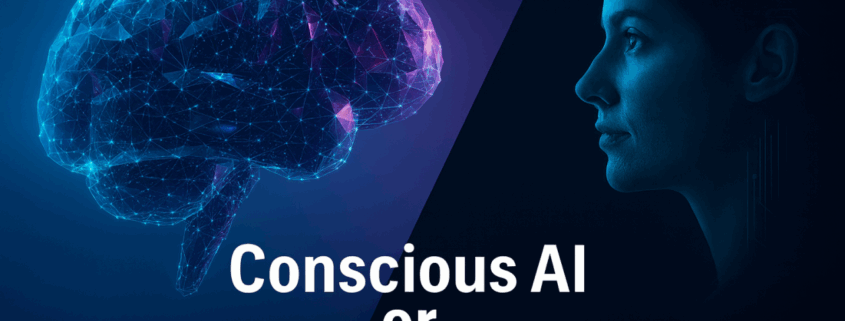
🧠 Conscious AI or Conscious Illusion? Why the Debate Matters More Than Ever
The latest headlines warn us of “seemingly conscious AI.” Mustafa Suleyman, CEO of Microsoft AI, described the emergence of AI that appears conscious as “inevitable and unwelcome.” His concern is clear: while AI is becoming more powerful, we risk encouraging the illusion that these tools are thinking entities.
And he’s right to raise the alarm.
But here’s the deeper issue: the danger lies not in AI suddenly “waking up,” but in how humans perceive and interact with these systems.
1. The Illusion of Consciousness
Modern AI models are extraordinary mimics. They generate text, speech, even emotional tones that feel real. Yet this is simulation, not sentience. The risk is that users—especially vulnerable ones—blur that line, attributing feelings, intent, or consciousness where none exists.
This isn’t a technical problem alone; it’s a legal, ethical, and societal problem.
2. The Rise of “AI Psychosis”
The article references “AI psychosis” — a non-clinical but important concept describing cases where individuals form unhealthy dependencies on chatbots.
From a legal-tech perspective, this raises serious questions:
- Should regulators treat AI systems as potential risks to mental health?
- What liability might fall on companies if users suffer harm from over-reliance?
- How do we balance innovation with protection?
Much like tobacco or gambling, overuse isn’t just a matter of choice—it’s a matter of design. When AI is engineered to be hyper-responsive, empathetic, and available 24/7, human attachment is almost inevitable.
3. Building AI “For People”
Suleyman argues: “We must build AI for people; not to be a digital person.”
I agree—but I would push further.
Building AI “for people” means embedding safeguards into law, design, and professional standards:
- Transparency: Clear communication that AI is not conscious.
- Guardrails: Defaults that reduce over-dependence (e.g., session limits, wellness checks).
- Legal frameworks: Accountability for firms that encourage anthropomorphisation as a selling point.
In legal practice, for example, AI should be a colleague to the lawyer, not a substitute for the lawyer. A drafting assistant, not a “thinking partner.”
4. Where We Go From Here
The arrival of “seemingly conscious AI” is less about AI’s internal state and more about our collective responsibility.
We must resist the temptation to market tools as “alive.” We must educate users to engage critically. And we must recognize that, in law, technology is only as safe as the frameworks we build around it.
Because the real danger isn’t a machine that thinks. It’s a society that forgets the difference.
✅ Key Takeaway
AI is powerful. It can assist, accelerate, and even empathize in convincing ways. But it cannot feel, suffer, or decide. If we blur that distinction, we risk not only confusion—but real harm to trust, mental health, and the rule of law.
#AIRegulation #LegalTech #AIethics #ConsciousAI #FutureOfLaw #AITechResponsibility