
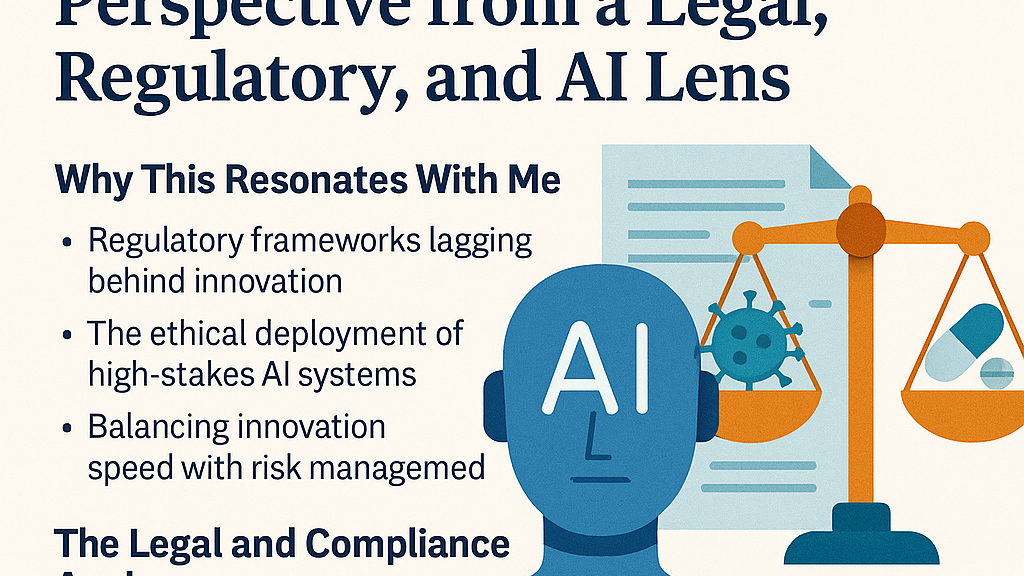
Could AI Save Us from the Antibiotic Apocalypse? My Perspective from a Legal, Regulatory, and AI Lens
The Sky News report by Thomas Moore highlights groundbreaking research from MIT, where generative AI is being used to design entirely new antibiotics against deadly superbugs like MRSA and drug-resistant gonorrhoea.
This isn’t just a medical milestone—it’s an AI milestone with far-reaching implications across law, regulation, and public health policy.
Why This Resonates With Me
My work sits at the intersection of AI, law, and access to justice—and while my focus is often on legaltech, the principles and challenges in medtech AI mirror those in my sector:
- Regulatory frameworks lagging behind innovation
- The ethical deployment of high-stakes AI systems
- Balancing innovation speed with risk management
Antibiotic resistance is a global crisis, killing around five million people a year. The fact that the last major class of antibiotics was discovered in the 1980s underscores the urgency. AI’s ability to design molecules atom-by-atom and model their toxicity before they’re ever synthesised could dramatically accelerate the drug discovery pipeline—something traditional R&D has struggled to do efficiently.
The Legal and Compliance Angle
The AI-driven drug discovery process raises important legal considerations:
- Data governance: What patient datasets (if any) are used in training models, and how is consent handled?
- Regulatory approval: How will agencies like the FDA, EMA, or MHRA adapt review processes for drugs discovered by algorithms?
- Liability: If an AI-designed antibiotic later has unforeseen side effects, where does legal responsibility fall—developer, manufacturer, or AI system owner?
Lessons for Legaltech
The parallel is striking: in both drug discovery and legal services, AI’s value lies in its ability to generate, filter, and optimise possibilities far beyond human capacity—whether that’s millions of molecules or millions of legal scenarios. The challenge in both is trust:
- Trust in the AI’s process
- Trust in the verification methods
- Trust in the governance that oversees deployment
Why It Matters Now
Many pharmaceutical companies abandoned antibiotic R&D due to cost and high failure rates. If AI can reduce that risk, it may revive an industry segment vital to human survival. Similarly, in law, AI may revive and expand access to legal support where human resource shortages and cost barriers have historically restricted it.
Both fields stand to benefit from reduced development cycles, lower costs, and more personalised, effective solutions—but both will fail without robust ethical, regulatory, and societal safeguards.
Closing Thought: If AI can help us avert an antibiotic apocalypse, it will be because humans built the right frameworks around it—legal, ethical, and operational. That’s as true for healthcare as it is for the justice system.





Leave a Reply
Want to join the discussion?Feel free to contribute!