
Apple’s Voice-First Overhaul: What It Means for Legal Tech (and Why Family Law Practitioners Should Care)
Apple is reportedly preparing a voice-first transformation of Siri—slated for spring 2026 with iOS 26.4—that could fundamentally change how we interact with devices and apps.
With an enhanced App Intents framework, users will be able to control apps entirely by voice, executing complex, multi-step tasks like:
- Editing and sending legal documents or evidence images
- Filing or updating court forms
- Posting to client portals or social media
- Making payments or managing banking transactions
- Booking professional services or appointments
- Accessing healthcare or support services
For legal technology—including tools used in international family law—this shift offers both groundbreaking opportunities and serious challenges in areas like compliance, accessibility, privacy, and liability.
Why Family Law Practitioners Should Pay Attention
While the headlines focus on convenience, the real impact will be in how voice-first systems can transform client communication, document handling, and evidence gathering.
Imagine:
- A client in another jurisdiction securely dictating their witness statement straight into your case management system.
- Voice-triggered retrieval of case law or court directions mid-meeting.
- Instant transcription and filing of parenting schedules or financial disclosure updates.
These capabilities could be a lifeline for clients with disabilities, limited literacy, or high emotional stress—but only if implemented safely and inclusively.
Key Legal Tech Implications
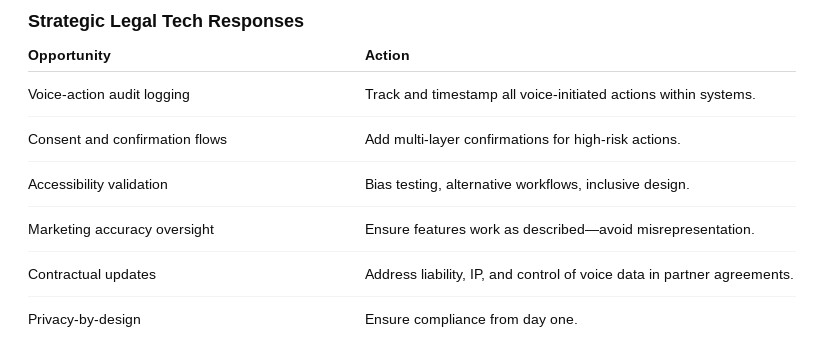
- Regulatory Risks Around Voice-Based Transactions Transferring funds or sharing sensitive data via voice will require robust authentication, explicit consent, and auditable logs—with compliance spanning GDPR, UK Data Protection Act, HIPAA, and jurisdiction-specific rules.
- Accessibility & Inclusion Voice interfaces can boost accessibility but risk exclusion if speech recognition struggles with accents, impairments, or noisy environments. Tools must meet obligations under the UK Equality Act and similar laws.
- Liability for Mis-Triggered Actions Misheard commands could cause financial loss or accidental disclosure. Clear confirmation steps and “undo” functions are essential.
- E-Discovery & Audit Readiness Verifiable, timestamped audit trails of voice actions will be vital in regulated environments—and invaluable if court proceedings require review.
- Updated Contracts & IP Integration with third-party apps will require revisiting agreements to clarify IP, data control, and liability in case of misuse.
- Privacy & Data Handling Voice brings unique privacy risks. Systems must adopt privacy-by-design to ensure lawful, transparent, and user-centric processing.
My Take
As someone interested in the intersection of international family law and legal tech, I see this as more than just a UI upgrade. It’s a paradigm shift that could:
- Reduce barriers for vulnerable clients
- Speed up case preparation across borders
- Support truly inclusive digital justice …but it will also demand proactive governance to prevent abuse, discrimination, or compliance breaches.
Firms that start preparing now—by building audit trails, consent layers, and inclusive design principles—will not only protect themselves legally but also lead the way in client service innovation.
💬 What’s your view? Will voice-first tech be an accessibility breakthrough or a compliance minefield for family law? I’d love to hear how your team is preparing—and whether you think clients will trust voice for legal interactions.
#LegalTech #InternationalFamilyLaw #DigitalJustice #AccessToJustice #AI #PrivacyByDesign #Apple #VoiceFirst #LawTechInnovation




Leave a Reply
Want to join the discussion?Feel free to contribute!