
Apple’s Voice-First Overhaul: What It Means for Legal Tech
Apple is reportedly planning a voice-first transformation of Siri that could fundamentally change how users interact with devices and apps. Slated for release in spring 2026 with iOS 26.4, this overhaul will leverage an enhanced App Intents framework—allowing users to control apps entirely by voice, including executing complex, multi-step tasks like:
- Editing and sending documents or images
- Posting to social media
- Making purchases or banking transactions
- Booking appointments
- Accessing healthcare services
The potential is huge—but so are the legal, compliance, and risk implications. For legal tech professionals, this development opens both opportunities and challenges in compliance, accessibility, privacy, and liability management.
Key Legal Tech Implications
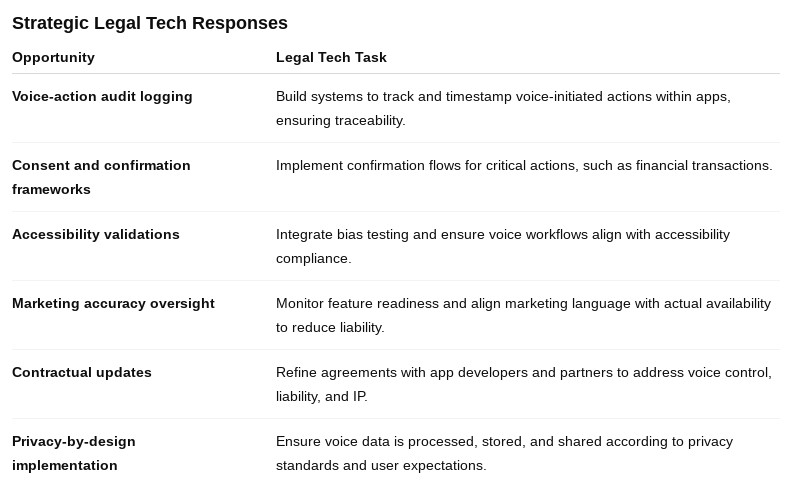
1. New Regulatory Risks Around Voice-Based Transactions Voice commands enabling sensitive actions—such as transferring funds or accessing personal health data—will demand robust authentication, explicit consent, and auditable logs. Compliance with GDPR, UK Data Protection Act, HIPAA (US), and other jurisdiction-specific rules will be critical.
2. Accessibility & Inclusion Requirements Voice interfaces can be a game-changer for accessibility—but also risk exclusion if speech recognition fails for diverse accents, speech impairments, or noisy settings. Legal tech must ensure accessibility testing, bias detection, and alternative controls to meet obligations under laws like the UK Equality Act.
3. Liability for Mis-Triggered Actions A misunderstood voice command could trigger an unintended purchase, post, or data disclosure. Clear “confirmation” layers and undo functions will be vital to mitigate legal disputes.
4. Compliance, E-Discovery & Audit Readiness Voice actions will need verifiable audit trails—including timestamps, user identity confirmation, and accurate transcripts. This is especially relevant for regulated industries where voice-initiated activity could be subject to investigation or litigation.
5. Intellectual Property & Third-Party Contracts Apple’s integration with third-party developers will require updated agreements covering IP ownership of voice-triggered processes, data control, and liability in case of errors or misuse.
6. Consumer Protection & Marketing Claims Past lawsuits have shown the risks of marketing features that aren’t ready or don’t work as advertised. Voice-first capabilities must be staged, tested, and truthfully represented to avoid false advertising claims.
7. Privacy & Data Handling Challenges Voice interactions bring unique privacy risks, such as unintended recording of sensitive information. Legal tech will need to build privacy-by-design frameworks to ensure lawful, transparent, and user-centric voice data handling.
The Bottom Line for Legal Tech Leaders
Apple’s voice-first evolution represents a paradigm shift in digital interaction—one that legal tech can’t afford to ignore. From risk mitigation to compliance innovation, there’s an urgent need for legal technology providers, in-house teams, and law firms to start preparing now for voice-driven workflows.
Firms that adapt early—by implementing audit trails, robust consent flows, inclusive design, and updated contractual frameworks—will not only stay compliant but also position themselves at the forefront of the next wave of user-interface transformation.
💬 What’s your view? Will voice-first legal tech be an accessibility breakthrough, or a compliance minefield? I’d love to hear how your firm or team is preparing.





Leave a Reply
Want to join the discussion?Feel free to contribute!