
AI Sandboxes: Europe’s Quiet Revolution in Responsible Innovation
Everyone in tech and law is talking about the EU AI Act. Most of the conversation has been about risk classifications, frontier models, and the looming weight of compliance.
But almost no one is talking about the Act’s most practical tool: the regulatory sandbox.
Too often dismissed as a bureaucratic hoop, the sandbox is in fact one of the most powerful mechanisms Europe has built for bridging the gap between innovation and governance. If we get this right, sandboxes won’t slow AI down — they’ll accelerate adoption, trust, and market confidence.
The Blind Spot in AI Governance
Right now, companies are caught between two extremes:
- On one side, policymakers and researchers focus on existential AI risks and high-risk system classifications.
- On the other, businesses are rushing to integrate APIs and third-party AI tools without fully grasping the legal or technical implications.
The missing middle? A place where innovators and regulators can safely test, learn, and clarify.
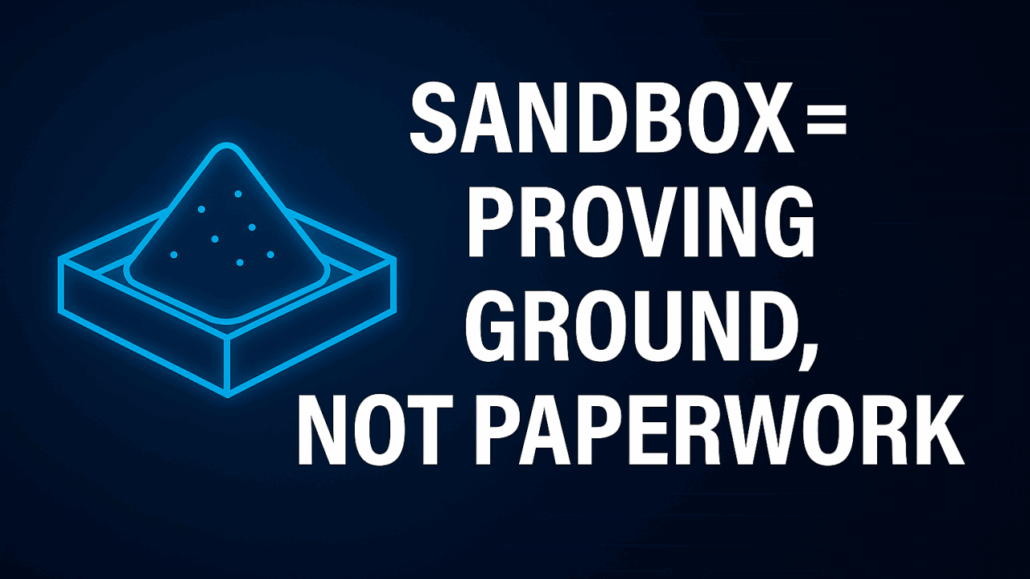
That’s what sandboxes are designed to provide: a proving ground, not a paperwork exercise.
What the Sandbox Really Is
It’s tempting to think of a sandbox as just a technical testing environment. But the EU AI Act reimagines it as something more powerful: a structured dialogue between innovators, regulators, and civil society.
In practice, that means:
- Trialling AI systems under supervision before they hit the market.
- Working directly with National Competent Authorities (NCAs) to understand compliance expectations.
- Involving independent experts and civil society to challenge assumptions and keep the public interest in focus.
Instead of asking forgiveness later, businesses get a controlled space to ask permission — and clarity — before scaling.
Why Legal Teams Should Care
For legal professionals, the sandbox is not a “nice to have.” It’s a strategic tool.
⚖️ Liability clarity: Who’s responsible when AI gets it wrong? The sandbox is where those frameworks can be tested and documented.
⚖️ IP and data usage: Many AI tools come with murky licensing or “data for improvement” clauses. Sandboxes allow these issues to be stress-tested before contracts are signed at scale.
⚖️ Data protection compliance: GDPR, CCPA, and future global frameworks impose strict obligations. Sandboxes let companies trial real-world data flows in a legally controlled space.
⚖️ Governance evidence: If litigation or regulatory challenge comes later, documented sandbox participation can show that a business acted responsibly and proactively.
The Business Advantage
This isn’t just about compliance. Companies that treat sandboxes seriously will gain real commercial benefits:
✅ Trust with regulators → smoother approvals and fewer costly surprises. ✅ Trust with customers → proof that products were tested for fairness, safety, and transparency. ✅ Trust with investors → reduced legal and reputational risk makes innovation more fundable.
In a crowded market, compliance is not a cost. It’s a competitive differentiator.
The Bigger Picture
Sandboxes are not meant to operate in isolation. The EU AI Act envisions them as part of a wider ecosystem, where lessons from one sandbox can feed into others, creating shared playbooks for responsible innovation.
At the same time, national flexibility ensures that sandboxes can adapt to specific market contexts. That balance — harmonisation with local nuance — is how Europe can set the global standard for AI governance.
Closing Thought
The EU AI Act’s sandbox is not red tape. It’s a roadmap.
For innovators, it’s the space to experiment without fear. For legal teams, it’s a shield against uncertainty. For regulators, it’s a mechanism for building trust.
And for Europe, it’s a chance to prove that responsible AI can also be competitive AI.
The challenge now is simple: will businesses treat sandboxes as a compliance checkbox, or as the proving ground where the next generation of AI trust is built?




Leave a Reply
Want to join the discussion?Feel free to contribute!